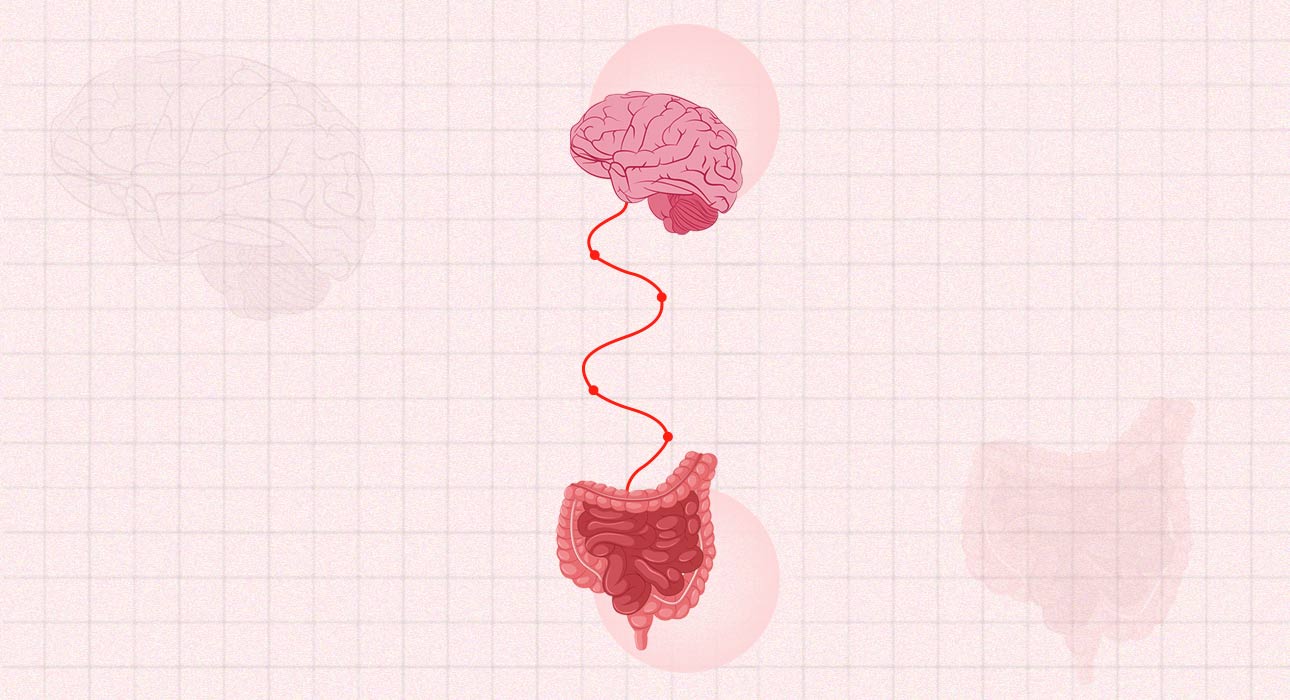
Have you ever wondered, whenever your stomach is upset, how instantly your mood and emotions change? Or whenever you feel anxious, there is a subtle manifestation of it in your stomach. This happens because the gut and the brain have a bidirectional relationship. Today, we often come across doctors, clinicians, and nutrition experts discussing gut Health. This article aims to understand the relationship between the Gut-Brain Axis, how constant low mental health impacts the gut and whether there is any relationship between our Brain and the digestive system.
The Brain: The Body’s Control Centre
The brain is one of the most essential, crucial and major organs of the human body. It controls both types of movements that are voluntary (walking, writing, reading, etc.)and involuntary(heartbeat, Blood Pressure, breathing, etc.) The brain has a lofty texture and layers. The brain is connected to the Spinal Cord. They both make up the Central Nervous System (CNS). The brain has four lobes: Occipital, Temporal, Frontal and Parietal Lobes. It has two halves or hemispheres: Left and Right.
We need to take utmost care of our brain, as once the brain gets injured or damaged due to any reason, it becomes difficult to treat it, though science has advanced, and today most of the critical brain surgeries are successful. Although at times the changes are irreversible, for instance, the medulla oblongata, which lies in the brain stem, is extremely critical. If an accident injures it, the injury can become fatal.
The brain is the first brain; similarly, there lies another brain in the human body. Often called The Second Brain – Digestive System or Gastrointestinal Tract of Gut. They both are extremely active and highly connected amongst all the systems of the body. The brain and the gut communicate via Neurons and the Nervous System(Cleveland Clinic, 2025).
Read More: How Stress Affects the Brain and Behaviour?
The Gut: The Executor of Digestive and Mental Well-Being
The gut includes our entire digestive system, which is our Gastrointestinal Tract (GI), small and large intestine and our overall digestive functioning. It is often called the Second Brain because it has the ENS working for it. The bacteria and microorganisms that are present in our gut are known as the gut microbiome. Some of these bacteria are good for digestive well-being, whereas some of them cause problems. Gut microbiome can impact the functioning of the Nervous System through the gut – brain axis. There are some bacteria that tend to either produce or stimulate the neurotransmitters.
Gut health is extremely important because if our digestive system gets impaired, it has a lot of consequences on other bodily functions. Such as the immune system, mental health, excretory system, circulatory system, etc. If the food we consume is not broken down into vitamins, carbohydrates and proteins, then it becomes difficult for the body to repair( Cleveland Clinic,2023). After understanding the brain and the gut, let us now understand how they are interconnected with each other and what happens if one of them gets impaired.
Read More: How does our Gut Health Influence Mental Well-Being? Here’s what Experts say
How Gut Health Impacts Brain Health?
We understand that all the body parts and the circulatory system work with each other in coordination. If they don’t work in coordination, then the human body cannot function well. Similarly, our gut and brain interact with each other in a bidirectional manner. Let us understand how the gut and brain connect:
Neurotransmitters and Bacteria
Research has shown that neurotransmitters are products of certain bacteria. In simple terms, some bacteria happen to produce neurotransmitters. Lactobacillus, Bifidobacterium, Escherichia, Enterococcus and Trichuris produce neurotransmitters and neuropeptides. Some of these include gamma-aminobutyric acid (GABA), serotonin and brain-derived neurotrophic factor (BDNF). This shows that the gut and brain are simultaneously working together to keep our body in balance(Rieder et al., 2017).
Hormones/ Neurotransmitters and the gut
- Serotonin: About 95% of Serotonin is produced in the gut, but not in the brain.
- Cortisol: This is the stress hormone/neurotransmitter that is released due to excessive stress affecting the gut and gut microbiome.
- Ghrelin: The hunger hormone, which is produced in the gut when it travels to the brain and signals that it’s time to eat.
- Leptin: Signals the brain to stop once you are full. (Rieder et al., 2017)
These hormones provide evidence that the brain and Gut are working together via Neurons. Neurons are the building block which help transmit the messages from the brain to the gut and vice versa.
Read More: Connection Between Gut- Brain & Alzheimer’s Disease: Study
Enteric Nervous System
As it was mentioned earlier, the gut is also called the Second Brain. Our gut has over 500 million neurons operating, sending messages and controlling essential functions. This is a complex network, hence it is known as the second brain. The Enteric Nervous System is a part of the Autonomic Nervous System. The neurons present in the Autonomic Nervous System of the Peripheral Nervous System and the Central Nervous System work together while sending chemical messages(Cleveland Clinic,2023).
So far, researchers have understood how the brain and the gut connect with each other through an axis. One part is dependent on the other. We discussed the primary and essential aspect, which helped us to understand that there is definitely a connection between the Gut and our brain.
Barriers to the Gut-Brain Axis
Recent developments in the understanding of the Gut – Brain – Microbiome System have allowed researchers to examine the barriers that pose challenges in the interaction:
- According to (Mayar et al. 2022), the intestine consists of two important layers: epithelial cells and the mucus layer, which is organised and attached to the epithelial tissues. If, by any chance, there is any dietary or fibre deprivation, it leads to thinning of the outer layer. If there is any kind of chronic stress, it also leads to thinning of the outer layer, impairing our gut health. Researchers call this structure the intestinal barrier.
- There are certain proteins, such as Claudin – 5 and occludin, that tend to upregulate and tighten the protein junction. This mechanism tends to decrease the blood permeability.
Permeability means the materials allow other components to easily pass through. This is called the blood-brain barrier. This somehow indicates that the gut impacts the blood circulation.
Impact of Gut health on mental health
Poor functioning of gut health directly impacts the functioning of mental health. For example, if there is an upset stomach, there is an instant drop in mood. Individuals automatically feel agitated and irritated. Whenever individuals experience stress, they often feel anxious and report headaches and nausea. This example illustrates the bidirectional nature of the gut and the brain.
Research done by (Wallace & Milev, 2017) has shown the effects of Probiotic Supplements on mental aspects such as mood, cognition and Stress and anxiety. Let us examine one by one :
- Effects on Mood: Participants reported significant improvements after taking probiotic supplements for 2 weeks. There was a shift from a low mood state to a high mood state.
- Effects on stress and anxiety: Those at higher genetic risk for social anxiety (indexed by high neuroticism) showed fewer social anxiety symptoms when they consumed more fermented foods. The impact of Probiotics on stress and anxiety was positive.
- Effects on Cognition: There was a significant improvement in the cognitive fatigue measures.
Read More: Ultra-Processed Foods and Executive Function: How Diet Impacts Brain Health
Fascinating Facts About the Human Gut
- The gut contains more neurons than our spinal cord.
- The surface area of our gut is approx the size of a tennis court.
- The weight of the gut microbiome is 2 kg. The same microbiome that helps us with the process of digestion.
- The gut produces about 1 litre of mucus, which helps us protect from the harmful bacteria and helps in easy food digestion.
- The immune system’s home is our digestive tract.
- The gut can produce its own antibiotics. ( Dr. Dilip,2024)
Conclusion
The brain gets the signals from neurons via neurotransmitters, and it functions accordingly. The gut is known as our second brain, as the Enteric Nervous System (ENS) is functioning continuously. They both form an axis by sending signals to each other. Mental health impacts our gut health, and our gut health impacts our mental health.
Researchers in recent developments have attempted to understand the barriers between the gut and brain. Researchers should conduct more concrete studies to better understand the connection between mental health and gut health. The above explanations to Gut – Brain Axis explain how neurochemical imbalances, psychological factors and social factors influence the gut-brain axis.
References +
Cleveland Clinic. (n.d.). Brain. Cleveland Clinic. https://my.clevelandclinic.org/health/body/22638-brain
Cleveland Clinic. (n.d.). Gut microbiome. Cleveland Clinic. https://my.clevelandclinic.org/health/body/25201-gut-microbiome
Cleveland Clinic. (n.d.). The gut-brain connection. Cleveland Clinic. https://my.clevelandclinic.org/health/body/the-gut-brain-connection
Hopkins Medicine. (n.d.). The brain-gut connection. Johns Hopkins Medicine. https://www.hopkinsmedicine.org/health/wellness-and-prevention/the-brain-gut-connection
Narayana Health. (n.d.). Did you know? Essential facts about gut health and digestion. Narayana Health. https://www.narayanahealth.org/blog/did-you-know-essential-facts-about-gut-health-and-digestion
Rieder, R., Wisniewski, P. J., Alderman, B. L., & Campbell, S. C. (2017). Microbes and mental health: A review. Brain, Behaviour, and Immunity, 66, 9–17. https://doi.org/10.1016/j.bbi.2017.01.016
Sarkar, A., Lehto, S. M., Harty, S., Dinan, T. G., Cryan, J. F., & Burnet, P. W. J. (2016). Psychobiotics and the manipulation of bacteria–gut–brain signals. Trends in Neurosciences, 39(11), 763–781. https://doi.org/10.1016/j.tins.2016.09.002
Sherwin, E., Dinan, T. G., & Cryan, J. F. (2018). Recent developments in understanding the role of the gut microbiota in brain health and disease. Annual Review of Medicine, 69, 357–373. https://doi.org/10.1146/annurev-med-042320-014032
Smith, P. A. (2015). The tantalising links between gut microbes and the brain. Nature, 526(7573), 312–314. https://doi.org/10.1038/526312a
The gut microbiota and brain–gut axis in behaviour and brain disorders. (2014). Nature Reviews Gastroenterology & Hepatology, 11(5), 306–318. https://pmc.ncbi.nlm.nih.gov/articles/PMC4191858/
Wallace, C. J. K., & Milev, R. (2017). The effects of probiotics on depressive symptoms in humans: A systematic review. Annals of General Psychiatry, 16(1), 14. https://doi.org/10.1186/s12991-017-0138-2
Westfall, S., Lomis, N., Kahouli, I., Dia, S. Y., Singh, S. P., & Prakash, S. (2021). Microbiome, probiotics and neurodegenerative diseases: Deciphering the gut-brain axis. Cellular and Molecular Life Sciences, 78, 613–633. https://pmc.ncbi.nlm.nih.gov/articles/PMC8263213/