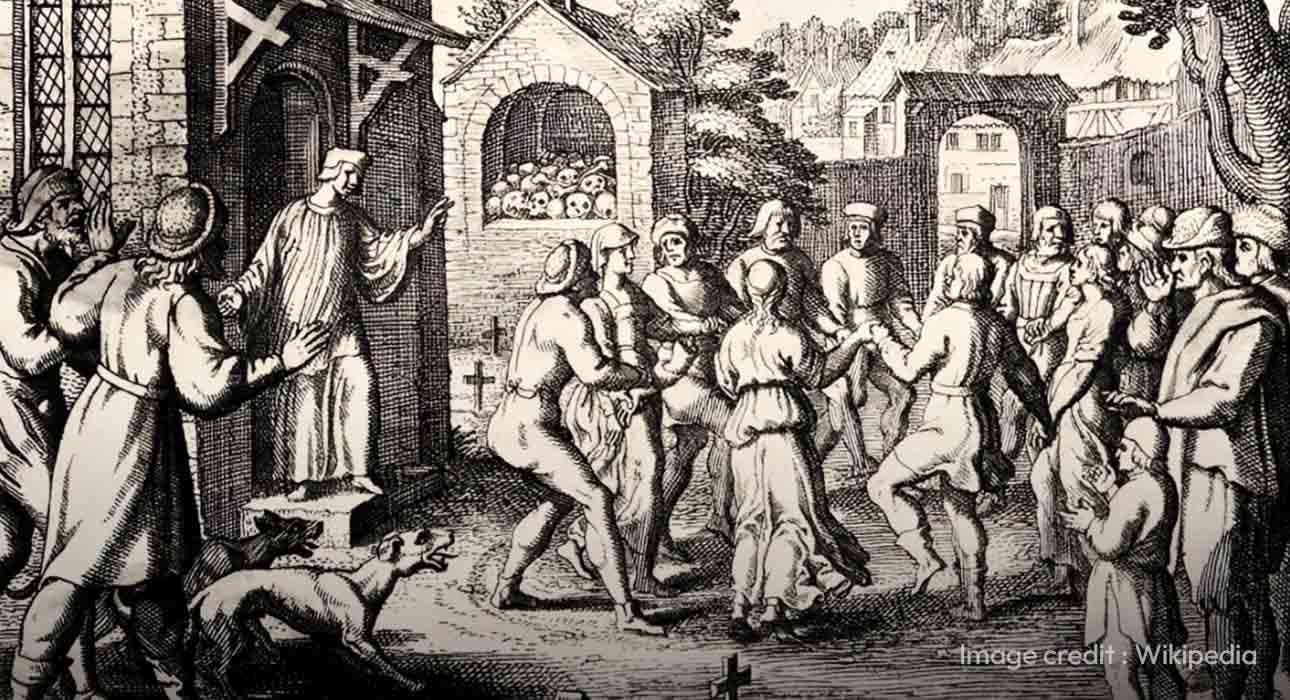
What if an entire crowd could catch an illness without a virus? Assume, walking through a town square and witnessing dozens of people dancing wildly. At first, it feels like a lively celebration. As the hours and then the days pass by, the dancers cannot stop; their feet bleed, and their bodies collapse with exhaustion, yet they continue to move uncontrollably. Soon, more people are drawn into the crowd and start acting like the other ones. Panic sets in, doctors are baffled, and authorities feel powerless.
This surreal phenomenon, which is said to have occurred in the summer of 1518 in Strasbourg, then part of the Holy Roman Empire, saw hundreds of people dance uncontrollably for days, or even weeks (Waller, 2009). Though historians and psychologists continue to debate about its cause, perhaps the most compelling explanation is ‘Mass Psychogenic Illness’ (MPI), a condition whereby symptoms of distress manifest physically and are transmitted through social means rather than biological ones (Bartholomew & Wessely, 2002).
Far from being a curious medieval anomaly, the Dancing Plague serves as a vivid reminder of how profoundly stress, fear, and collective belief can impact human behaviour. As we navigate an age of viral misinformation, social media panics, and collective anxiety, the six-hundred-year-old story of Strasbourg seems remarkably modern even today.
The Strange Summer of 1518
The curious occurrence began in July 1518 when a woman named Frau Troffea started to dance manically in the streets of Strasbourg. According to historical records, she danced for several days without taking a rest. It was not long before other people also started joining her, and within a month the number of dancers had reached around 400 people (Waller, 2009).
The town officials, unaware of the unusual symptoms, simply concluded that if they danced enough, they would get it out of their systems, so they provided a dance area in the public square as well as paid musicians. However, this proved futile; in fact, the symptoms worsened. It is even alleged that some of the afflicted even suffered stroke or heart attacks, while others simply wore themselves to death (Backman, 1952). Key Characteristics of the Dancing Plague:
- Sudden occurrence within one individual, followed by rapid spread.
- Primarily affected the general population.
- Compulsive dancing, exhaustion, and emotional distress were major symptoms.
- Researchers found no evidence that infections or toxic substances caused the incident.
- Medical professionals could not develop a successful treatment for the condition (Waller, 2009).
Although accounts vary slightly regarding some specifics, scholars are fairly confident that the occurrence of this strange incident was very real, and although over time, there is some exaggeration about some details (Midelfort, 1999).
Read More: Sitting Too Long Linked to Heart Disease: Study Reveals Alarming Insights
Understanding Mass Psychogenic Illness
Mass Psychogenic Illness (MPI), sometimes also called Mass Psychogenic disorder or Epidemic Hysteria, is a relatively well-documented phenomenon where physical symptoms suddenly spread throughout a group or community, but have no recognisable organic basis for their development. The experienced symptoms are genuine and involuntary (Bartholomew & Wessely, 2002). MPI commonly occurs in settings where a community is experiencing intense stress, uncertainty or fear. The signs of MPI are quite common and may include:
- Dizziness and fainting
- Tremors or shaking
- Nausea and headaches
- Motor disturbances or unusual movements
- Breathing difficulty and a feeling of weakness (Boss, 1997).
It is believed that extreme psychological distress has a direct link with the human nervous system, which can cause bodily symptoms, and with time, it transmits from person to person through social observation and shared belief. This is a psychological phenomenon which is known as social contagion (Bartholomew & Wessely, 2002).
In many aspects, the Dancing Plague fits the description of MPI; the people of Strasbourg were experiencing a multitude of psychological stressors, they were in a state of severe anxiety, their strong cultural belief dictated their perception, and the symptoms were spread through observation rather than infection (Waller, 2009).
Stress and Fear in Medieval Europe
To understand why the Dancing Plague may have occurred, it is important to grasp the historical context of the society under pressure. In 1518, Strasbourg had been going through a constrained period of repeated famine, widespread food shortages, outbreaks of diseases, and economic hardship for centuries; the majority of its inhabitants lived in poverty and constant fear of the future (Waller, 2009). Key contributors to societal stress in Medieval Europe:
- Recurrent food shortages and rising prices
- Frequent epidemics and fear of death
- Strong religious beliefs in divine punishment
- Social inequality and political instability (Midelfort, 1999).
It is a well-known fact that prolonged stress can increase an individual’s susceptibility to physical and emotional health problems, and it is believed that when people endure overwhelming distress, they may express it as bodily symptoms (Boss, 1997). Within such an environment, unusual behaviours could rapidly spread, especially when communities interpreted them through shared religious or supernatural beliefs.
The Power of Social Contagion and Collective Beliefs
Humans are inherently social beings, and the people around us largely influence our actions. While this can often be helpful, under stressful situations, this susceptibility may become a dangerous force, enabling large groups of people to exhibit similar reactions through observation.
Religious beliefs heavily influenced medieval society, and it was a common belief that the dance manias were the result of an evil hex cast by saints, in particular by Saint Vitus, who was believed to curse people with uncontrollable movements (Backman, 1952). Such beliefs may have shaped how individuals interpreted bodily sensations and emotional distress. The ways Social Contagion may occur:
- The new individuals observe symptoms displayed by another member of their social group
- They use social clues to make sense of their own symptoms
- Anxiety increases bodily awareness
- New individuals begin to mimic the symptoms of others
- The phenomenon spreads among the members of the specific community (Bartholomew & Wessely, 2002).
The ability for a group to act like each other under extreme stress does not suggest irrationality or lack of self-control on the individual’s part, but the immense power of how closely the mind and body interact within a social environment.
Read More: Faith as a Coping Mechanism: Understanding Its Role During Times of Uncertainty
Modern-day examples of Mass Psychogenic Illness (MPI)
Though the Dancing Plague appears to be a relic of the past, MPI occurs in contemporary society. There are reports of widespread episodes of MPI occurring in schools, workplaces, and communities globally. The following examples reflect this:
- A brief mention of the Bartholomew and Wessely (2002) account of the 1962 Tanganyika laughter epidemic, when a hundred-plus school-children and their families succumbed to the same infectious attack of uncontrollable giggling.
- ∙Episodes of inexplicable fainting and dizziness occurred in schools across Africa and Asia in the mid-20th Century (Boss, 1997).
- Reports of mysterious illnesses linked to fear of environmental toxins despite the absence of harmful exposure (Jones et al., 2000).
Most recently, psychologists have begun to understand how social media’s rapid spread of information might magnify group fears and produce widespread psychosomatic illness (Van Prooijen & Douglas, 2017). The lesson is not that symptoms are imaginary. Rather, psychological and social influences can produce authentic physiological experiences that deserve empathy and scientific understanding to deal with.
The Dancing Plague: Lessons for Today
The Dancing Plague of 1518 is an interesting reminder that when things get desperate, it is not always a plague that kills, but a panic, and the true explanation for the ailments may lie in the psychological state rather than a physical one. Today, the reason for anxiety may have shifted far from the people in 1518; however, this does not make the message of the ‘Dancing Plague’ irrelevant. In a society where chronic stress, misinformation, social isolation, economic instability and global crises are common occurrences, people must address the issue of Mass Psychogenic Illness (MPI).
In treating the symptoms of an outbreak, everyone must show compassion to those affected, everyone must help the community deal with any underlying issues of anxiety and panic, and most importantly, everyone must stop demonising or belittling the victims (Bartholomew & Wessely, 2002).
Conclusion
Five hundred years on, historians, psychologists and neuroscientists debate and ponder whether the Strasbourg Dancing Plague was the result of Mass Psychogenic Illness, stress or a combination of factors related to biology and culture. One thing remains clear: the body and mind are inseparable entities. Fear can spread among people through observation. Beliefs can influence perceptions, and shared emotion can have a lasting effect on human lives and societies.
As people continue to navigate their own age of anxiety and information, the case of 1518 Dancing Plague continues to maintain an emphasis on compassion, analysis and psychological fortitude in all aspects of human existence. After all, what we discover is that when our bodies succumb to illness, sometimes the illness is just a response of the mind.
References +
- Backman, E. L. (1952). Religious dances in the Christian church and in popular medicine. Allen & Unwin.
- Boss, L. P. (1997). Epidemic hysteria: A review of the published literature. Epidemiologic Reviews, 19(2), 233–243.
- Midelfort, H. C. E. (1999). A history of madness in sixteenth-century Germany. Stanford University Press.
- Jones, T. F., Craig, A. S., Hoy, D., et al. (2000). Mass psychogenic illness attributed to toxic exposure at a high school. The New England Journal of Medicine, 342(2), 96–100.
- Bartholomew, R. E., & Wessely, S. (2002). Protean nature of mass sociogenic illness: From possessed nuns to chemical and biological terrorism fears. The British Journal of Psychiatry, 180(4), 300–306.
- Waller, J. (2008). A forgotten plague: Making sense of dancing mania. The Lancet, 373(9664), 624–625.
- Waller, J. (2009). A time to dance, a time to die: The extraordinary story of the dancing plague of 1518. Icon Books.
- Van Prooijen, J. W., & Douglas, K. M. (2017). Conspiracy theories as part of history: The role of societal crises. Memory Studies, 10(3), 323–333.
- American Psychiatric Association. (2022). Diagnostic and statistical manual of mental disorders (5th ed., text rev.). American Psychiatric Publishing.