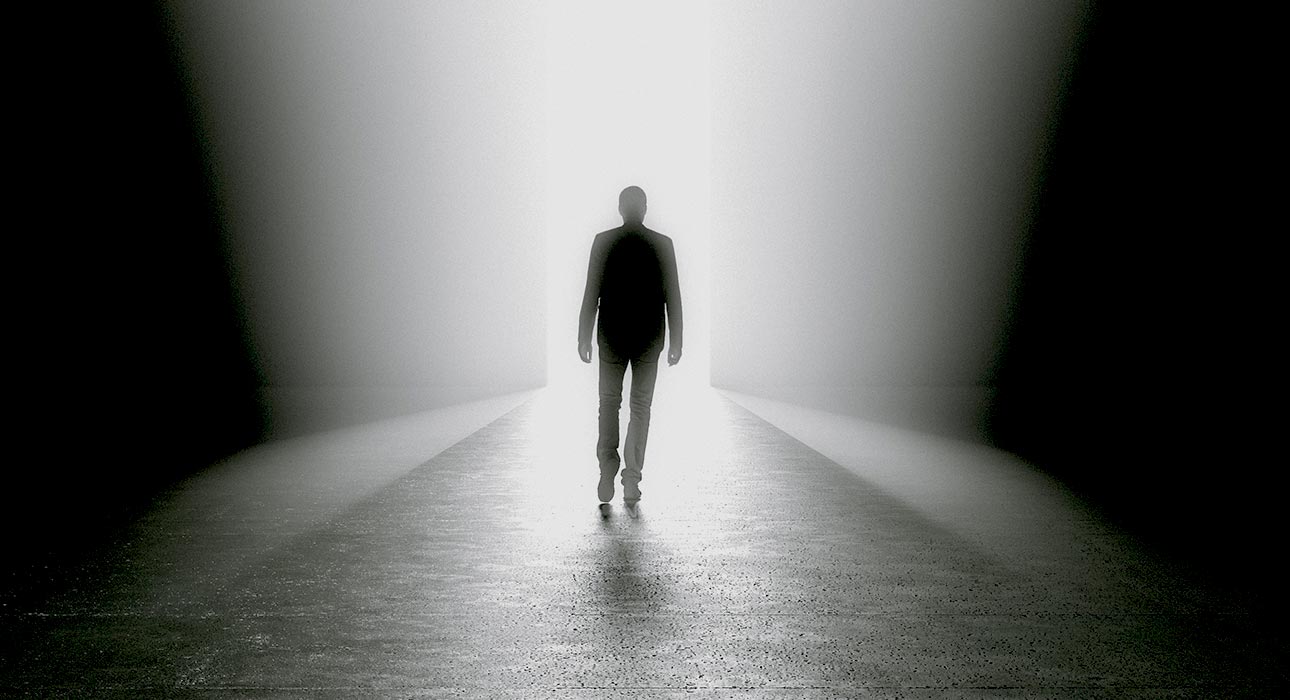
An emanating light beckons, the cushiony, pale wisps coiling around the treacherous, crimson contour of your utterly still heart. It sings an enticing and honeyed tale of unending respite, the sinister lull of permanent vacuity. You are neither below nor above, neither with colour nor without, as your breath remains frozen, transitional and hesitant. The silvery tendrils of fawning light ask you to succumb to vicious solace, but should you? How could you leave behind the painful yet vivacious persistence of life and the fulfilment of timeworn love? What would you do if you remained suspended between the thrumming vibrance of life and the imminent stillness of death?
Near-death experiences (NDEs) are difficult to discuss because every explanation seems to reveal something while leaving another part unresolved. Neuroscience can explain why perception changes when the body is under extreme medical stress, psychology can explain why the self might detach when death feels imminent, and culture can explain why one person encounters Jesus while another encounters an ancestor or unnamed presence. None of these explanations settles the central question of whether an NDE is entirely generated by the brain or whether consciousness can under extreme conditions exceed the body that usually contains it.
An NDE may include heightened sensory awareness, mental clarity, detachment from the body, movement through darkness or a tunnel, brilliant light, panoramic life review, encounters with deceased relatives or religious figures and return to bodily awareness. DeSpelder and Strickland describe several neuropsychological mechanisms that could account for these features, including reduced oxygen reaching the brain, unusual activity in the temporal or limbic regions, endorphin release, reduced control over brain activity, sensory deprivation, drug effects and internally generated imagery (DeSpelder & Strickland, 2014).
Reduced oxygen can alter visual processing, attention and consciousness during a medical crisis. Endorphin release may reduce pain and create emotional calm, while reduced control over neural activity may allow unusual sensations or images to enter consciousness. Out-of-body experiences are relevant because feeling located inside one’s body depends on the brain successfully combining visual information with our sense of movement, balance and physical position. Blanke and colleagues demonstrated that electrical stimulation near the right angular gyrus could induce bodily detachment in an epilepsy patient, suggesting that disruption in this process can produce a convincing sense of leaving the body (Blanke et al., 2002).
Psychological explanations extend this argument beyond what is happening physically inside the brain. Oskar Pfister interpreted Near-death experiences through shock and depersonalization, while Russell Noyes and Roy Kletti described resistance, life review and transcendence as stages within a defensive response to mortal danger (DeSpelder & Strickland, 2014). During resistance, the person recognises danger and struggles against approaching death. During life review, personal memories emerge as the experiencing self becomes psychologically separated from the threatened body. Also during transcendence, ordinary ego identity weakens and may be replaced by a sense of wider or even cosmic consciousness.
This account makes psychological sense because the threatened self has a powerful motive to preserve a sense of continuity. Depersonalization can create distance from bodily danger, while motivated fantasy can create an impression of survival when death feels imminent. The mind may protect itself by moving the sense of identity away from the physical body and into an observing self that seems untouched by physical collapse. This could explain why people describe watching their resuscitation, feeling peaceful while critically unstable or experiencing themselves as part of something larger than their individual identity.
Culture enters the experience because nobody approaches death without previous beliefs, memories, language and expectations. Religious systems provide ideas through which unfamiliar experiences become understandable, while cultural learning provides familiar images for explaining something that may otherwise feel impossible to describe. A 2023 systematic review found recurring NDE features across cultures, including bodily separation and altered perception, while interpretations varied across social and religious contexts (Hashemi et al., 2023).
Belanti, Perera and Jagadheesan also found that cultural background influences how Near-death experiences are described and understood (Belanti et al., 2008). Culture therefore appears capable of influencing interpretation without completely determining what someone experiences. An atheist may experience unity, light or a presence without calling it God, while a Christian may understand similar sensations through Christian imagery. What happens neurologically and how someone later understands that experience may belong to different psychological levels.
The most difficult cases involve reported awareness during cardiac arrest. In the AWARE study, Parnia and colleagues examined 2,060 cardiac arrests and identified survivors who reported memories connected with their resuscitation. One 57-year-old man described people, sounds and events from his resuscitation, including an automated defibrillator command, during a period when normal brain functioning would have been severely affected (Parnia et al., 2014). The case cannot establish that consciousness existed independently of his brain, although it raises an important question about how much awareness can remain during extreme physical crisis.
The later AWARE II study adds another layer because researchers recorded organised electrical brain activity connected with cognitive processes during prolonged cardiopulmonary resuscitation (Parnia et al., 2023). This supports the possibility that the brain can continue producing meaningful activity during states previously assumed to contain very little consciousness. It also reminds us that our measurements remain incomplete, since someone showing no outward response may still be having an internal experience. I find the most convincing position somewhere within that uncertainty.
Neuropsychology explains many NDE features with impressive precision, psychology explains why the self might detach or experience transcendence, and culture explains why similar experiences acquire different religious meanings. None of these explanations fully answers what consciousness itself is or whether consciousness can exist independently from the brain activity through which we usually study it. Raymond Moody eventually rejected claims that Near-death experiences provide scientific proof of an afterlife, while DeSpelder and Strickland also preserve the distinction between explanation and certainty (DeSpelder & Strickland, 2014).
That caution matters because certainty in either direction goes beyond the evidence currently available. Near-death experiences may be extraordinary products of a brain trying to preserve continuity when death feels close. They may also reveal aspects of consciousness that neuroscience still cannot fully explain. The unresolved question remains simple despite everything neuroscience can tell us. If the brain creates an experience, does that make the experience less real? If consciousness is always experienced through the brain, how would we recognize an experience that somehow extended beyond it? I am less interested in proving an afterlife than in asking whether our current understanding of consciousness is complete enough to dismiss the possibility.
References +
- Belanti, J., Perera, M., & Jagadheesan, K. (2008). Phenomenology of near-death experiences: A cross-cultural perspective. Transcultural Psychiatry, 45(1), 121–133.
- Blanke, O., Ortigue, S., Landis, T., & Seeck, M. (2002). Stimulating illusory own-body perceptions. Nature, 419(6904), 269–270.
- DeSpelder, L. A., & Strickland, A. L. (2014). The last dance: Encountering death and dying (10th ed.). McGraw-Hill Education.
- Hashemi, A., Oroojan, A. A., Rassouli, M., & Ashrafizadeh, H. (2023). Explanation of near-death experiences: A systematic analysis of case reports and qualitative research. Frontiers in Psychology, 14.
- Kondziella, D., Dreier, J. P., & Olsen, M. H. (2019). Prevalence of near-death experiences in people with and without REM sleep intrusion. PeerJ, 7, e7585.
- McLaughlin, S. A., & Malony, H. N. (1984). Near-death experiences and religion: A further investigation. Journal of Religion and Health, 23(2), 149–159.
- Parnia, S., et al. (2014). AWARE: AWAreness during REsuscitation: A prospective study. Resuscitation, 85(12), 1799–1805.
- Parnia, S., et al. (2023). AWAreness during REsuscitation II: A multi-center study of consciousness and awareness in cardiac arrest. Resuscitation, 191, 109903.